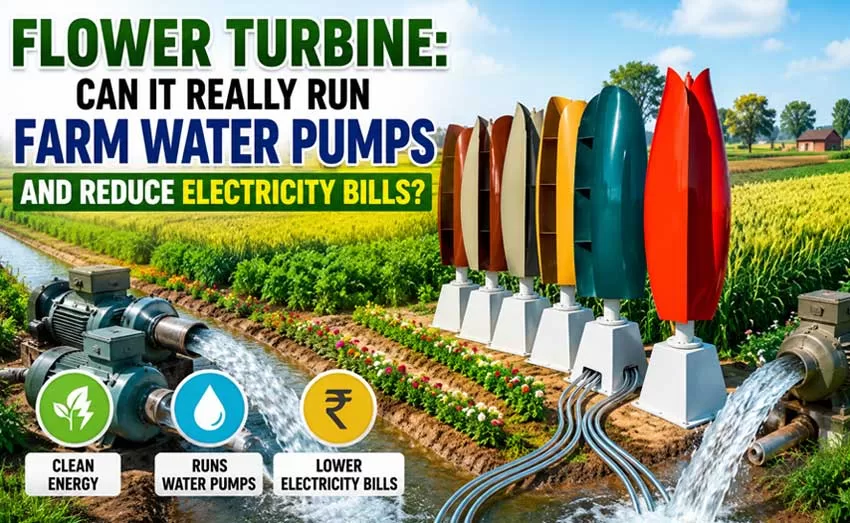
Flower Turbine: Can It Really Run Farm Water Pumps and Reduce Electricity Bills?
The rising cost of electricity is a big problem for both farmers and homes. Many are now looking at alternative energy alternatives that can lessen reliance on grid energy and cut the monthly utility bills.
One device that has generated a lot of attention on social media is the Flower Turbine, a contemporary wind-powered electricity producing system. There are several videos that say that a Flower Turbine can power water pumps, power homes and perhaps get rid of electricity costs altogether.
But how much of this is the truth?
In this post, we will talk about how Flower Turbines function, their pros and cons, installation requirements, and whether or not they are a viable alternative for farmers and homeowners.
What’s a Flower Turbine?
A Flower Turbine is a form of Vertical Axis Wind Turbine (VAWT) used to produce electricity from wind energy.
Unlike standard horizontal wind turbines, Flower Turbines look like flowers, which is beautiful to look at and can also catch wind blowing in all directions.
They are compact in design, so they may be used in residential properties, farms, commercial buildings and any area where space is limited.
How Does a Flower Turbine Function?
The principle of operation is easy:
The turbine blades or petals are hit by the wind.
The blades start to move.
The rotation of a shaft attached to a generator.
The generator produces electrical energy from mechanical energy.
Electricity is either stored in batteries or used to power appliances and equipment.
The amount of electrical power generated depends only on the wind speed and the efficiency of the turbine.
Can a Flower Turbine Power a Farm Water Pump?
Yes, but in the correct conditions.
A well built wind energy system can help operate:
Water pumps for agriculture
Borewellpumps
Lighting for agriculture
Battery charging methods
Small farm machinery
Real world performance will be affected by:
Wind resources
Turbine power output
Battery storage
System design
Power needs of pump
The Truth Behind “Zero Electricity Bills
One of the most common fallacies on the web is that if you build a wind turbine you would never have to pay an electricity bill again.
So, generally zero electricity bills means:
Good wind resources
Store battery appropriately.
Efficient system design
Hybrid Wind-solar Integration
These factors are needed to meet the expectations of the outcomes.
Why Some Wind Turbine Owners Are Disenchanted
Many users do erect wind turbines without doing a full site assessment, however.
Typical reasons for a bad performance are:
Low wind speed
wrong turbine selection
Bad installation height
Buildings and trees are obstructions
Bad quality controllers.
Insufficient battery systems
A wind turbine is not a plug and play product. Site conditions are important to success.
Vertical & Horizontal Wind Turbines
Flower turbines (Vertical Wind Turbines)
Advantages:
Catch the breeze from every direction
Work in gusty wind conditions
Takes up less space
Be silent and work
Suitable for urban and residential areas.
Cons:
More initial expenditure
Lower efficiency for some big scale applications
Wind Turbines (Horizontal)
The Upside:
High efficiency in the open space
Less expensive per watt
Perfect for farms and rural properties
Cons:
Highly dependent on wind direction
Need more space for installation
Can make more noise
For open land agricultural applications, horizontal turbines are generally more economical. Flower Turbines could be more suitable for residential rooftops and urban areas.
Wind Speed Matters
The most critical factor in wind energy generation is wind speed.
Power production increases considerably with a little increase in wind speed.
Before purchasing any turbine, property owners should consider:
Mean wind speed
Seasonal wind patterns.
Buildings and other amenities
Height of Mounting
Even the best turbine in the world won’t work well if the wind resource isn’t strong enough.
Mistakes People Make Often
Avoid these typical mistakes before erecting a wind turbine:
1. Too Low Installation
Mounting heights are kept low to limit exposure to prevailing wind.
2. Ignoring the obstacles around it
Tall structures, trees, towers and hills obstruct airflow.
3. Buying on Advertised Power Ratings Alone
Even if a turbine is certified for a given power output, that doesn’t guarantee it’s providing that power at all times.
4. Utilizing Bad Quality Controllers
The quality of the controller directly influences the charging efficiency and the performance of the battery.
5. Overlooking Battery Storage
Power availability is uncertain without appropriate batteries.
6. Wind Assessment Omitted
Many purchasers never check the local wind conditions before they buy.
Why Solar-Wind Hybrid Systems Are Better
So the experts tend to talk about wind turbines with solar panels.
Day time
Solar panels produce electricity.
In the night.
Wind turbines can provide power as long as there’s wind.
Advantages:
More dependable energy
Better battery charging
Less dependency on the grid
Reduced power bills
This is a combo that is growing more and more popular all throughout the world.
Are Flower Turbines Suitable for Farmers?
When a Flower Turbine could be an excellent option:
The wind is frequent on your farm.
Irrigation needs power.
You have battery storage already.
You want to cut long term electric bills.
You intend to use it in conjunction with solar energy.
But if wind conditions are bad, solar power alone may have a superior return on investment.
Benefits of Flower Turbines
Source of renewable energy
Reduced electric bills
Less diesel consumption
Eco-friendly
In the case of hybrid systems
Can back agricultural operations
Disadvantages of Flower turbines
Driven by wind availability
Higher up-front investment
Results may vary by store location
Batteries needed for constant power
Not all properties are perfect
Summary
Flower Turbines are an innovative form of sustainable energy generation. They can help farmers and homeowners cut electricity bills, help in water pumping applications and increase energy independence.
Success, however, hinges on accurate site selection, sufficient wind resources, proper installation and realistic expectations.
Wind turbines are not the magic cure for free electricity . They are part of a well designed renewable energy system that may incorporate battery storage and solar power .
In the correct conditions, a Flower Turbine can prove to be a profitable long-term investment for farms, houses and companies.
Frequently Asked Questions (FAQs)
Que 1. What is a Flower Turbine?
Ans. The Flower Turbine is a vertical axis wind turbine that converts wind energy into electricity. The flower-shaped design enables it to receive wind from different directions and function in tight areas.
Que 2. Can a Flower Turbine power a water pump for irrigation?
Ans. Yes a correctly sized Flower Turbine system can help to drive agricultural water pumps. Performance, however, depends on wind speed, battery storage, pump capacity and overall system design.
Que 3. Can a Flower Turbine make your electricity bill disappear forever?
Ans. Not necessarily. The generation of electricity depends on the availability of wind. In places where the wind blows hard and steady, it can cut electricity bills dramatically, but it won’t necessarily eliminate them altogether.
Que 4. What is the best site for installing the Flower Turbine?
Ans. Best place is an open region with constant wind flow and not many impediments like towering buildings, trees, towers or hills.
Que 5. What makes a Flower Turbine different from a conventional wind turbine?
Ans. A Flower Turbine is generally a vertical axis wind turbine able to collect wind from numerous directions. More standard wind turbines are often horizontal axis turbines, and work best in open locations with continuous wind flow.
Que 6. Does a Flower Turbine operate at night?
Ans. Yes, Unlike solar panels, wind turbines can produce electricity both day and night, if there is enough wind.
Que 7. Is a battery needed for a Flower Turbine?
Ans. A battery is highly suggested because it can store surplus electricity and give power when wind speed dips or ceases.
Que 8. Is a Solar-Wind Hybrid System superior to a stand alone Flower Turbine?
Ans. Yes, in most circumstances. A hybrid system combines solar during the day and wind during windy times or at night for more reliable electricity generation.
Que 9. What are the restrictions of Flower Turbine?
Ans. It is quite sensitive to wind availability, installation quality, and battery storage. Low wind speed areas may not produce the desired outcomes.
Que 10. Is it possible for farmers to utilise Flower Turbines for farming?
Ans. Yes, Farmers can utilise Flower Turbines to power irrigation systems, farm lights, battery charging and other low to medium power needs of agricultural applications.
Que 11. Should I Invest in Flower Turbine in India?
Ans. In areas with good wind resources, a Flower Turbine can be a useful long term investment to help cut energy costs and increase energy independence.