Laser Weeding Machines: Revolutionizing Weed Management in Modern Farming
All farmers know the frustration of weeds. They creep in within days after sowing, take water and nutrients meant for the crop, and compel farmers into an endless cycle of hand-weeding, spraying, or paying labour that is increasingly harder to find every season. For decades, the only true choices were human weeding, mechanical equipment, or chemical herbicides — each with its own cost, whether in money, time, or soil health.
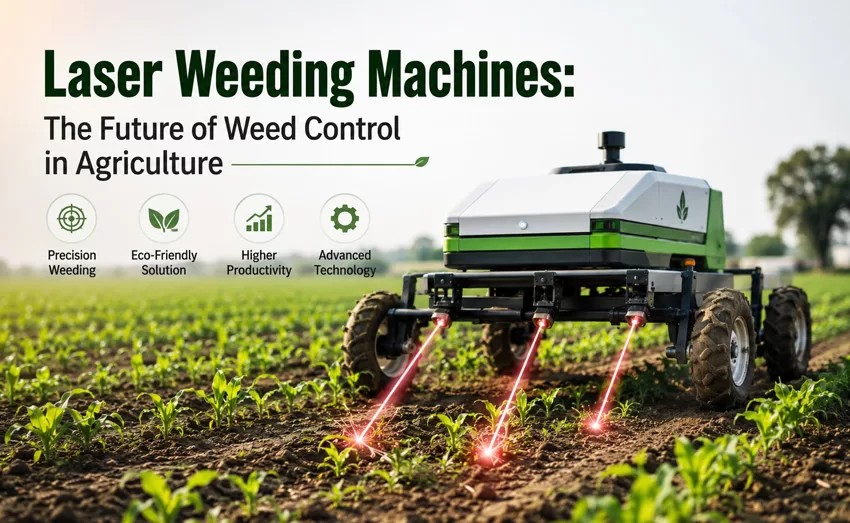
A newer approach is now changing that equation: laser weeding. Instead of pulling, tilling, or spraying, these machines use cameras and artificial intelligence to spot a weed and a focused laser beam to destroy it — without ever touching the crop growing right next to it.
What Is a Laser Weeding Machine?
The laser weeder is a clever, camera-guided device that identifies weeds in a field and kills them with a laser pointed directly at the weed, not with a nozzle filled with herbicide. The laser is aimed at the weed's growing point, heating it just enough to kill the plant tissue so the weed can't come back or spread.
That means a bunch of different technologies working together under the hood: high-res cameras, AI models trained to distinguish crops from weeds, location sensors, laser modules, and — in field-ready versions — an interface with a tractor so the complete unit can travel over big plots on its own.
How Does Laser Weed Control Work?
- Scanning: The equipment uses cameras to take photos of the field as it moves.
- Detection: AI software trained on thousands of photos of crops and weeds tells the two apart in real time.
- Targeting: After weed identification, the system pinpoints the exact location of the weed's growing point.
- Elimination: A laser fires at that point, and the resulting heat destroys the plant's ability to grow further.
Today, the best systems execute all four steps in a fraction of a second per weed — which is what makes it practical to cover real farm acreage, not just a test plot.
Benefits of Laser Weeding Machines
- Cuts down herbicide use. Weeds are eliminated physically, not chemically, so no herbicide residue is left in the soil or on the crop.
- Good for the planet. Less spraying means less risk to groundwater, soil microorganisms, and pollinators like bees.
- Handles herbicide-resistant weeds. In recent years, several common weeds have become resistant to popular herbicides. A laser doesn't rely on chemistry, so resistance isn't an issue.
- Reduces dependence on farm labour. With manual weeding labour becoming scarcer and costlier in many regions, an automated system that runs continuously is a real relief for farmers.
- Opens the door to organic certification. For organic farms that can't use synthetic herbicides, this offers a scalable, chemical-free weeding option.
- Can run around the clock. Many systems are built to keep working after dark, letting a farmer cover more ground without extra shifts of manual labour.
Who's Building This Technology?
Carbon Robotics (USA) is one of the world's most recognisable names, bringing together AI-enabled cameras and high-powered lasers for large-scale row-crop farms. Escarda Technologies is another player developing laser-based weeding systems aimed at sustainable agriculture.
Laser Weeding in India: Where Things Actually Stand
Laser weeding is a technology that is emerging quickly in India — quicker than many farmers realise. The most closely watched name here is Harvested Robotics, a Hyderabad-based firm started in 2023 by two Mahindra University engineering graduates, Rahul Arepaka and George Mathew. They've built a device called Rakshak, a tractor-mounted, AI-driven laser weeder built for Indian field conditions.
A few numbers give a sense of why this matters:
- The ICAR-Directorate of Weed Research estimates that weeds cost Indian agriculture around $11 billion a year in lost production.
- A farmer typically spends around ₹15,000 per weeding round, repeated three to four times in a season — bringing the annual cost to about ₹60,000.
- Harvested Robotics aims to cut that weeding cost by 40–50% once Rakshak is commercially available.
- The latest Rakshak prototype can scan, detect, and burn a weed in under 0.5 seconds, with targeting accuracy of around 5 mm.
The firm is incubated at the Atal Incubation Centre, Mahindra University, and is a member of the Microsoft for Startups Founders Hub. It has run pilot trials with Mahindra & Mahindra, and raised a ₹5 crore pre-seed round led by Arali Ventures, with participation from Anand Mahindra and Country Delight co-founder Chakradhar Gade — a strong signal of industry confidence, even though the product is still moving through field trials rather than mass deployment.
Challenges Facing Laser Weeding in India
High upfront cost. Laser weeders use advanced hardware, which currently makes them pricier than a hand hoe or a chemical sprayer — though Indian startups are explicitly trying to build cheaper versions than the roughly $1-million systems sold abroad.
Scattered small holdings. Much of India's agriculture is parcelled out into small plots, so machinery built for large row-crop farms needs re-engineering to be useful here.
Crop and weed diversity. India grows an enormous range of crops, each with its own local weed species. AI models need extensive, India-specific training data to work reliably across regions.
Low awareness levels. The technology is new, so many farmers haven't heard of it yet, or don't know how it compares to what they currently use.
What's Next for Laser Weeding
As costs come down and more field data improves detection accuracy, laser weeding is set to move from pilot trials to real farms over the next few years — starting on larger, better-resourced farms, and gradually working its way down the chain as tractor-mount kits and rental models make the technology more accessible to small and medium farmers. The direction is clear: chemical-free, AI-guided weeding is on track to become a common tool, not a curiosity, thanks to the government's push for sustainable and digital agriculture, along with rising herbicide resistance and workforce shortages.
Conclusion
Laser weeding is a genuinely new approach to one of farming's oldest challenges, bringing together artificial intelligence, computer vision, and precise laser technology. It's still early days in India, but with homegrown innovations like Rakshak moving through field trials and drawing serious investor backing, the technology is closer to Indian farms than it might appear. For farmers watching where mechanisation is headed next, laser weeding is worth keeping an eye on.
FAQs
Does laser weeding damage the crop?
No. The system learns to differentiate between crops and weeds, and only fires at the weed's growing point, leaving adjacent crop plants unaffected.
Do Indian farmers use laser weeding today?
Not commercially yet. Indian startups like Harvested Robotics are in field trials, with commercial rollout likely as the technology evolves and costs come down.
How is laser weeding different from pesticide spraying?
Herbicides can leave residues in soil and on crops. Laser weeding uses heat to physically remove weeds and leaves no chemical residue behind.
Can laser weeders work with existing tractors?
Yes — several designs, including Rakshak, are built to be mounted on or towed behind tractors farmers already own, rather than requiring a completely new machine.